If you’ve ever stood in a food processing plant, a pharmaceutical manufacturing facility, or even a craft brewery, chances are you’ve run into one of our stainless steel tanks. I’m Mark, and I’ve spent the last 12 years in this business—visiting factories, answering thousands of questions from owners and engineers, and fixing more tanks than I can count. One question that always pops up, especially when teams are designing a new line or upgrading an existing process, is this: “What’s the magnetic property of stainless steel tanks?” It sounds like a small detail on the surface, but it’s actually one of the most important factors that affects how a tank performs, how it’s cleaned, and even how well it integrates with the rest of a facility’s equipment. Today, I want to break this down in plain terms, no confusing jargon, because I’ve seen too many projects go off track because someone didn’t get this right. Stainless Steel Tanks

First, let’s go back to basics. For anyone who doesn’t deal with metal alloys every day, stainless steel is a mix of iron, chromium, and other elements. The chromium is what makes it stainless—when it reacts with oxygen in the air, it forms a thin, invisible layer that keeps it from rusting. But not all stainless steel is the same. The two main types you’ll find in tanks are austenitic and ferritic. That’s where the magnetic difference starts.
Austenitic stainless steel is the most common for tanks, especially in food and pharmaceutical industries. It’s what you think of when you picture a shiny, smooth tank—304 and 316 grades, to name the two workhorses. Here’s the thing about austenitic stainless steel in its standard annealed state (which is how it’s shipped to us to make tanks): it’s almost non-magnetic. Wait, almost. There’s a small catch. When we form the sheet metal into a tank—bending it, welding it, rolling it into a cylinder—we add what’s called “work hardening.” That process rearranges the metal’s internal structure, and suddenly, a tiny bit of magnetism shows up. It’s not strong enough to stick a heavy magnet to, but run a small fridge magnet along a freshly bent edge or a weld seam on a 304 tank, and you’ll feel a faint pull. For most applications, this doesn’t matter at all. It’s barely measurable, and it fades a tiny bit over time as the metal stabilizes. But if someone is working with extremely sensitive equipment—like magnetic resonance imaging (MRI) components, or pharmaceutical products that need to avoid even trace magnetic particles—this small amount can be a concern. That’s why we always talk to those clients upfront, so we can either adjust the forming process or specify a different stainless steel grade.
Then there’s ferritic stainless steel. This is less common for large storage tanks, but you might see it in smaller parts or some specialized processing tanks. Ferritic stainless steel has a higher iron content and lower nickel than austenitic, and its internal structure is naturally magnetic. If you run a magnet along a tank made of 430 grade ferritic, it’ll stick firmly, no work hardening needed. The downside? Ferritic is less resistant to corrosion, especially in high-purity environments where tanks are repeatedly cleaned with hot, acidic chemicals. That’s why our standard line of bulk storage and processing tanks is almost all austenitic grade—304 for general use, 316 for applications that need extra corrosion resistance, like handling salt, dairy products, or certain chemicals. The trade-off with magnetism in austenitic tanks is a small one, and it’s easily managed with proper design and communication.
Now, let’s talk about why this magnetic property actually matters for a stainless steel tank, beyond just a fun fact about magnets. For our clients in the food and beverage industry, sanitation is king. Tanks are cleaned with CIP (clean-in-place) systems, which use high-pressure, high-temperature caustic solutions to remove every trace of product. If a tank has areas where magnetic particles could get trapped or attracted—like those slightly magnetic weld seams we talked about earlier—over time, tiny bits of iron or other ferrous materials from the manufacturing process could work their way loose. Those bits would then get into the cleaning solution, and if they’re not removed, they can contaminate the next batch of product. We solve this by doing a magnetic particle test on every tank before it leaves our facility. It’s a simple process where we run powerful magnets along the entire surface of the tank to catch any loose ferrous particles, and then we do a final passivation step to seal that chromium layer even tighter, which reduces the work-hardened magnetism almost completely.
Another big area is process integration. Many facilities connect stainless steel tanks to pumps, sensors, and other equipment that has magnetic components. If you have a tank that’s slightly magnetic, it can interfere with flow sensors or level sensors that use magnetic fields to measure levels. For example, a craft brewery I worked with last year had an issue where their fermentation tanks were messing up their CO2 level sensors. They’d installed standard 304 tanks, and the faint magnetism from the welds was throwing off the sensor readings, leading to inconsistent carbonation in their beer. We adjusted the weld process for their next order—using a smaller heat-affected zone that reduced work hardening—and then polished the welds to further minimize the magnetic pull. It fixed the problem, and they’ve been repeat clients ever since. That’s the kind of detail that makes a difference, right there. We don’t just sell tanks; we solve problems.
I also want to address a common misconception I hear all the time: people think all stainless steel is non-magnetic, or that if a tank is magnetic, it’s not “real” stainless steel. That’s just not true. The grade and the manufacturing process dictate magnetism, not the quality of the stainless steel. A well-made 304 austenitic tank is still high-quality, even if it has a faint magnetic pull on its welds. A ferritic tank that sticks strongly to a magnet is still stainless steel, but it’s just a different type meant for different uses. I once had a client who was shopping around for tanks and turned down a competitor’s quote because the salesman said their tanks were “magnetic, so they were cheap stainless steel.” The competitor actually used a high-grade 316 austenitic but was using a different forming process, and the client didn’t understand the difference. We ended up making them a set of tanks that matched their exact needs, and they told me later that the competitor’s tanks would have corroded within two years in their chemical processing environment. That’s why education is part of the job for us. We don’t just quote a price; we explain the why behind every choice.
Let’s also talk about testing and certifications. For industries like pharmaceuticals, medical devices, or aerospace, there are strict standards for metal purity and magnetic properties. We work with third-party labs to test every batch of steel we use, and every finished tank, to document its magnetic properties. We can provide test reports that show that our 304 and 316 tanks have a magnetic permeability of less than 1.005—meaning they’re almost indistinguishable from truly non-magnetic materials for all practical purposes. For clients that need even lower levels, we offer a special grade of austenitic stainless steel that’s stabilized with titanium or niobium, which reduces work hardening during forming and keeps the magnetism almost zero, even on welds. It’s a bit more expensive, but for the right client, it’s worth every penny to avoid contamination or equipment issues.
I’ve also learned that magnetism can be a useful tool for maintenance, when used correctly. If a tank has a build-up of hard water scale or residual product, sometimes running a strong magnet along the surface can pull loose any ferrous particles that are stuck to the inside walls, making cleaning easier. We actually recommend this as a regular maintenance step for our tanks, along with the standard CIP process. It’s a simple, low-cost trick that has saved a lot of our clients hours of scrubbing. But you have to be careful here—don’t use a magnet that’s too strong, or you could damage any sensor wiring or seals inside the tank. Our team gives a quick guide to every client on safe maintenance practices, so they get the benefit without the risk.
Now, I want to get personal here. I’ve been in this business long enough to see trends change, and I’ve worked with small, family-owned businesses and huge multinational corporations. What hasn’t changed is that when it comes to stainless steel tanks, clients want transparency. They want to know exactly what they’re getting, why it works, and that their investment will last. I’ve had clients come to us after a bad experience with another supplier—tanks that rusted, that were impossible to clean, that had hidden issues with magnetic properties that caused big problems in their process. Our team prides ourselves on not cutting corners, on being honest about the strengths and limitations of every tank we build.
Let me circle back to the original question: what is the magnetic property of stainless steel tanks? The short answer is that most of our tanks, made from standard austenitic stainless steel grades 304 and 316, are nearly non-magnetic, with only a faint, manageable magnetism in bent or welded areas that’s caused by work hardening. Ferritic stainless steel tanks are naturally magnetic, but they’re reserved for specialized applications where corrosion resistance isn’t the top priority. The long answer is that this magnetic property is a small but critical detail that affects sanitation, equipment performance, and long-term maintenance. It’s not something you have to stress over if you work with a supplier who knows what they’re doing, but it’s definitely something you should discuss upfront to avoid headaches down the line.
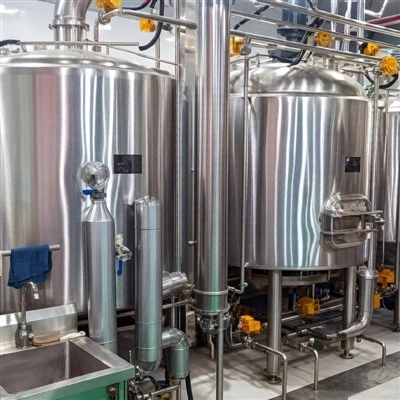
If you’re in the market for stainless steel tanks, whether for food processing, pharmaceuticals, brewing, water treatment, or any other industry, I can tell you that getting this right is half the battle. We build tanks to last 20, 30, even 40 years, and part of that is paying attention to every detail, from the grade of steel we start with to the way we form and weld each part. We’re always here to answer questions, walk you through the specs, and make sure you get exactly what you need, not just what you asked for. If you’re ready to chat about your next project, we’re just an inquiry away. Whether you need a single small tank for a pilot plant or a large custom system for a full production facility, we can help you design, build, and install a tank that works for your process, your budget, and your long-term goals.
Scale Beer Equipment References
ASM International. (2002). Stainless Steel Handbook. ASM International.
Brandestetter, W., & Vogelsang, M. (2018). Magnetic Properties of Austenitic Stainless Steels after Cold Working. Journal of Materials Engineering and Performance, 27(4), 1687-1694.
Food and Drug Administration. (2021). Material Compendia for Food Contact Substances. U.S. Food and Drug Administration.
Wenzhou Jinggong Machinery Equipment Co., Ltd.
We are one of the most professional stainless steel tanks manufacturers and suppliers in China. With abundant experience, we warmly welcome you to buy customized stainless steel tanks at competitive price from our factory. If you have any enquiry about quotation, please feel free to email us.
Address: No.Jiadi Industrial Zone, Yaoxi Town, Longwan District, Wenzhou City, China.
E-mail: jinggong2026@163.com
WebSite: https://www.jg-ind.com/
